
The growing mistrust between journalists and security forces leaves their relationship in balance
By Our Reporter
Whenever it comes to campaigns and voting, political mobilization period or protests, especially by opposition political parties, elements of the use of excess force by security forces to coerce the crowds are often common and some of these incidences are often justified by territorial commanders and the top most police command citing public safety concerns, violence, provocation and self-defense among others.
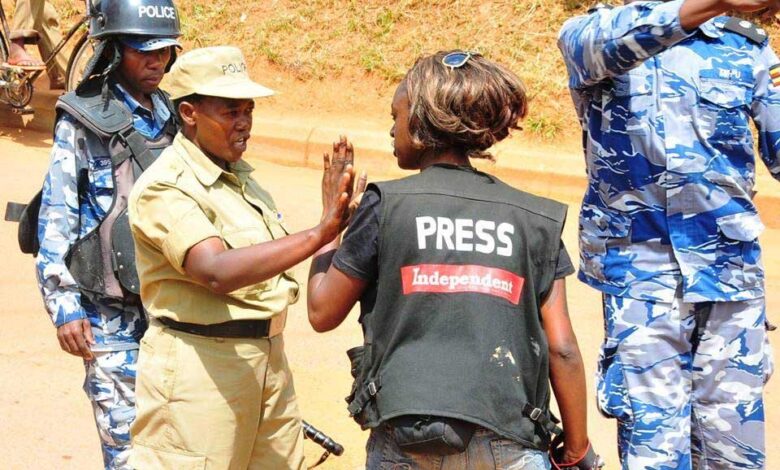
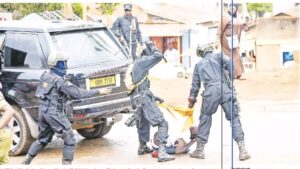
Just recently at least 18 journalists were violently attacked by security forces while covering the legislative by-elections in Kawempe North, a northern neighborhood in the capital Kampala. The Aviator Africa strongly condemns these aggressive assaults and calls on the authorities to guarantee journalists’ safety, namely by ensuring that the army’s commitments to press freedom are honored.
One of our Associate Editor at The Aviator Africa, Mr Daniel Bakalangudde was one of the victims and he narrates what happened. “After confiscating our shoes, watches and equipment, the officers, whose faces were masked, hit us on the head, ribs, elbows and knees. They told us to lie down in the van, then pretend to sleep, to snore.
They forced us to count to 15 and hit us at each number. The windows were covered, it was very hot, you couldn’t see anything.” All their equipment was destroyed, and every journalist had to receive hospital treatment.
Journalists Ibrahim Ruhweza and Isaac Nuwagaba from New Vision were also held blindfolded for 20 minutes in a van by masked members of the Ugandan security agency Joint Anti-Terrorist Task Force (JATT), who beat them with sticks and electric cables before forcing them to erase their videos.
At least 13 journalists were severely beaten that day, at least ten of whom went to hospitals. Several reporters who witnessed the violence chose to stop reporting and returned to their newsrooms while others took off their press vests to avoid being targeted.
However, claims of unfair police practices against journalists seem to have increased with the rise in media coverage and may negatively affect the already deteriorating public perceptions. Is this also becoming a policing policy by the Uganda Police?
According to NTV Uganda, Steven Mbidde, a journalist with the Nation Media Group, was reportedly assaulted by police officers at Wandegeya Police Station in Kampala while on duty. Mbidde was at the said station to follow up on individuals arrested after police dispersed National Unity Platform (NUP) supporters en route to Kawempe for campaigns supporting the party’s candidate in the Kawempe North by-election, Erias Nalukoola.
The attack comes just days after a similar incident involving a Top TV journalist Miracle Ibra, who was severely injured by police officers from the Joint Anti-Terrorism Task Force (JAT). Ibra’s skull and eye were left badly damaged, and he remains hospitalized as a result of the brutal assault. And Steven Kibwiika of Spark tv who was brutally attacked by security officials on Monday in Kawempe during the Elias Luyimbazi Nalukoola, Kawempe North NUP MP aspirant rally.
These excessive portrayals of police brutality may contribute to inaccurate public perceptions of how and why force is used. The questions of how and why remain unanswered especially when most of these victimized journalists are always identifiable as members of the press. The increasing mistrust between the police and journalists leaves their relationship in balance. Has anything been done to restore trust and confidence between the police and Journalism?
The right to access information is Constitutional under Article 41 of the constitution of Uganda with limitation in only cases where the information is likely to jeopardize national security or violate someone’s privacy.
As such, the police are likely to be subjected to criticism more frequently than other
occupations since crime and political stories receive more media attention by the public and the international community.
Recent technological advancements have only served to increase the level of public scrutiny experienced by police. Technological advancements in the form of body cameras, dash cameras, and cell phone cameras have given the public a “bird’s eye view” of police encounters.
Public scrutiny has also exponentially increased when surveillance is coupled with the use of social media and other digital sharing services which make it easier to publicize police encounters
Despite the public outcry regarding these events evidenced by numerous protests, police officers involved in such questionable applications of force are rarely charged. For example, in 2019, a group of about 50 journalists gathered at the city Centre to march to police headquarters protesting police brutality during Makerere University protests.
Justifications put forth for withholding information in the aftermath of use of force incidents often include ongoing investigations, pending litigation, privacy concerns, and even statutory limitations. These become very difficult to identify and apprehend the culprits
To make matters worse, when officers are prosecuted, sentences imposed are generally lenient for the crimes committed when compared to civilians found guilty of similar crimes
Stated differently, the lack of transparency and oversight accorded to police’s use of excess force and brutality could serve to perpetuate more misconduct through inadequate penalties (failure to charge perpetrators, non-indictments, and light punishments)
Yesterday, the deputy speaker of Parliament Rt Hon Thomas Tayebwa condemned the beating of journalists by security operatives, The Uganda Journalists Association (UJA) and the Uganda Parliamentary Press Association (UPPA) among others have come out to condemn the police brutalities against journalists.