
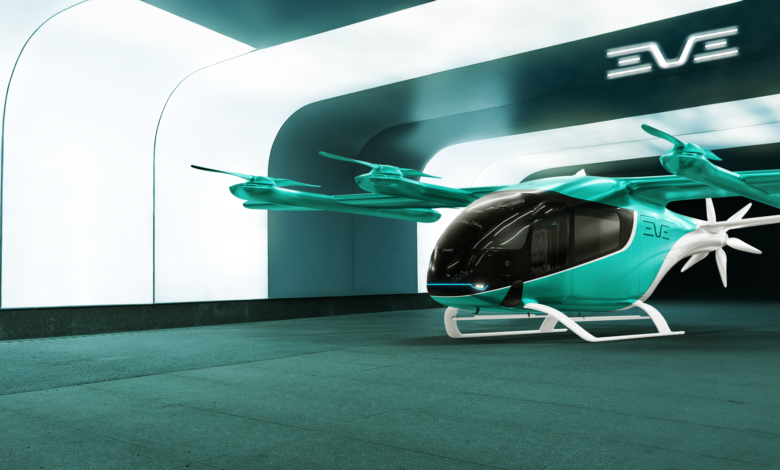
Eve Air Mobility named three new suppliers for its electric vertical takeoff and landing (eVTOL) aircraft. Garmin® (NYSE: GRMN), will supply the avionics for the aircraft while Liebherr-Aerospace will supply the flight controls actuators. Intergalactic will provide the thermal management system.
“We are looking forward to working with each of our suppliers as we progress with our eVTOL development,” said Johann Bordais, CEO of Eve Air Mobility. “Each of our suppliers undergoes a very stringent review that evaluates not only performance and quality of their product, but also their dedication to continuous improvement and customer support and satisfaction. We are looking forward to a long-term working relationship with each of our suppliers.”
Garmin will supply the G3000® Integrated Flight Deck for Eve’s eVTOL which features large-format, light weight, high-resolution glass displays integrating seamlessly with Eve’s vehicle management and flight control systems. Tailored for the needs of eVTOL aircraft, the flight deck’s intuitive touchscreen interface reduces pilot workload by providing direct access to a full suite of avionics capabilities including an integrated flight management system, NAV/COM radios, transponder, audio management and access to a breadth of applications including checklists, charts, synoptics, and full-featured maps.
Liebherr will develop electromechanical actuators (EMA) for the fly-by-wire flight controls of Eve’s eVTOL. Liebherr is well known for their expertise in the manufacturing of precision gears and dependable actuation, crucial for this type of technology. The actuators will be powered by the aircraft’s electrical system and the technology will ensure high performance, configurability and easier maintenance.
Intergalactic will provide the thermal management system which will maintain an optimal temperature range for equipment including batteries and other electronic components. The system will also help ensure a comfortable temperature inside the cabin of the aircraft.
The three new suppliers are in addition to three that were announced at the Paris Air Show this past summer. Nidec Aerospace LLC, a joint venture between Japan’s Nidec Corporation and Brazil’s Embraer, will provide the electric propulsion system for Eve’s eVTOL while BAE Systems will supply the energy storage system. DUC Hélices Propellers will provide the rotors and propellers.
Eve’s eVTOL aircraft utilizes a lift+cruise configuration with eight dedicated propellers for vertical flight and fixed wings to fly on cruise, with no change in the position of these components during flight. The latest concept includes an electric pusher powered by dual electric motors that provide propulsion redundancy while ensuring high performance and safety. While offering numerous advantages including lower cost of operation, fewer parts, optimized structures and systems, it has been developed to offer efficient thrust with low sound.
In July, the company announced that its first eVTOL production facility will be located in the city of Taubaté, in the state of São Paulo, Brazil. The company has begun assembly of its first full-scale eVTOL prototype which will be followed by a test campaign in 2024. Eve’s eVTOL is scheduled to begin deliveries and enter into service in 2026.
Concurrently, Eve continues to develop a comprehensive portfolio of agnostic service and operations solutions, including a unique Urban Air Traffic Management (Urban ATM) software to optimize and scale Urban Air Mobility operations worldwide.