
The 55th AFRAA Annual General Assembly Concludes In Kampala, Uganda
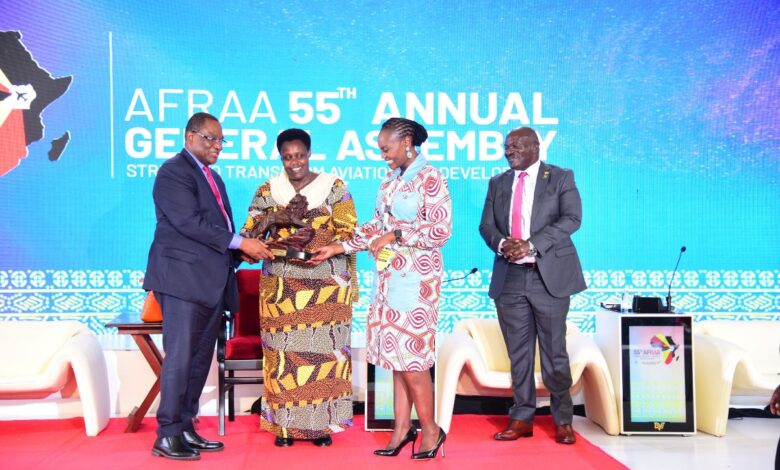
The African Airlines Association (AFRAA) and Uganda Airlines concluded the 55th Annual General Assembly (AGA) in Kampala, Uganda. The event was held under the High Patronage of the Government of Uganda and officiated by H.E Jessica Rose Epel Alupo, Vice President of the Republic of Uganda.
The Assembly, which brought together 569 delegates from 49 countries under the theme “Strides to Transform Aviation for Development“, challenged African airlines and air transport stakeholders with new thinking on initiatives and strategies that will drive the sustainability of the air transport sector to realise its potential. Among others, the Assembly recommendations were made on the following key areas:
- The Transformational value of the Single African Air Transport Market (SAATM) to African airlines.
- Collaborative and effective attainment of the Aviation Net Zero Roadmap
- Innovation initiatives in Africa for sustainable aviation in the continent
- Synergies for the development of intra-Africa tourism and air travel
- Gender diversity and inclusivity actions to shape the future of aviation in Africa
H.E Jessica Rose Epel Alupo – the Chief Guest, in her opening address, highlighted that Air Transport as the business of freedom, is a critical enabler of economic and social integration which Africa cannot do without because the rail and road infrastructure lack due coverage for interstate movement. “As Africa pursues the goal of continental integration, it will be important to focus on growing Air transport for ease of intra-Africa connectivity.” She stated.
“Air connectivity has become central to our development agenda, and the national carrier is seen as an extension of national infrastructure. We are committed to investing in the flag carrier and to facilitate the airline’s expansion within Africa, while also providing those vital air bridges between the continent and the rest of the world. For that reason, we are proactive in driving Africa’s integration agenda and committed to removing any obstacles that might obstruct this goal in way.” H.E Jessica Rose Epel Alupo added.
In her welcome address, Ms. Jennifer Bamuturaki, the 2023 President of AFRAA and CEO of Uganda Airlines took stock of the priorities for African air transport during the period of her Presidency of the Association, notably on: smart regulation to support liberalization and intra-Africa connectivity, pathways for increased partnerships and collaboration within the continent and promotion of sustainable operations of African airlines. She noted the positive traction on initiatives to open up the continent’s aviation and improve connectivity. “At least two-thirds of African states have signed up to SAATM and are at different stages of implementation. Here in Uganda, internal conversations about joining SAATM have started.” she stated.
Mr. Abdérahmane Berthé, AFRAA Secretary General, expressed commitment and determination of AFRAA to overcome the challenges facing the air transport industry, to support the post-COVID resumption and foster a resilient Air Transport system in Africa. “As our industry has almost recovered from the COVID-19 pandemic, it provides an opportunity for cooperation and collaboration to develop a sustainable perspective for the airline industry. At AFRAA, we will keep our mission to promote and serve African airlines and champion Africa’s aviation industry.” he stated.
“Better Skies for Africa remains the pillar of all our actions.” Mr. Berthé concluded.
Appointment of officers
The 55th AFRAA AGA elected LAM Mozambique as the Chairman of the Executive Committee while Kenya Airways was elected as first Vice Chairman and Tunisair as second Vice Chairman. The AFRAA Executive Committee has oversight responsibility for the Association.
Host of the 56th AGA
The 55th AFRAA AGA elected EgyptAir as the President of the Association. EgyptAir will host the 56th AGA in Egypt from in November 2024.
AFRAA CEOs retreat
As part of the pre-AGA activities, AFRAA staged the first-ever AFRAA CEOs retreat on 19 November 2023. The CEOs retreat is an initiative recommended by the AFRAA Executive Committee to bring together member airline Leadership Teams to brainstorm on the Association’s priorities, work plan, projects and specific dynamics of the air transport industry that will enhance the Association to play its critical role in the industry. The CEOs retreat which will be held on an annual basis, made recommendations for AFRAA on: safety, intra-African connectivity and route development, sustainability of African Airlines and AFRAA joint projects.
New Members and Partners
The Association welcomed the following new Members that joined in 2023:
- Eswatini Air (Associate Membership)
- Ibom Airlines (Full Membership)
- MedSky Airways (Associate Membership)
- Zambia Airways Ltd (Associate Membership)
- Airlink (Pty) Limited (Full Membership)
- Chapman Freeborn Airchartering Ltd – (Full Partnership)
- TP Connects (Full Partnership)
Highlights from the Secretary General’s State of the Industry report
Airline performance: The average Passenger Load Factor recorded in Africa for 2022 was 71.6%, a 10.6% increase compared to 2021. However, this is 7% less than the global average. The mismatch between capacity and demand and the limited commercial cooperation between local carriers may explain this low performance in terms of load factor in Africa.
In terms of passengers carried, during the 3rd quarter of 2023, African airlines reached the number of RPKs for the same period in 2019. AFRAA estimates the number of passengers in 2023 to be 85 million, 89% of the 95.6 million in 2019. Notably, in 2023, Northern Africa accounts for 39.5% of the total African traffic, followed by Central and West Africa at 21.7%, Southern Africa at 19.4% and Eastern Africa at 19.3.
On cargo, according to World ACD, African Airlines represent an average of 30.6% in terms of cargo market share in 2023.
AFRAA estimates the revenue loss for 2022 at USD 3.5 billion, representing 20% of 2019 revenues. This will narrow down to USD 1 billion in 2023.
Jet fuel prices: Jet fuel prices are rising, reaching $123.46 as at the end of October 2023. This trend of high fuel costs impacts fares and hinders air transport affordability for African citizens.
Safety: Promoting and enhancing safety is one of AFRAA’s priorities through collaboration. AFRAA and industry stakeholders are working towards improving safety standards in our continent. AFRAA is currently running with IATA and AFCAC a 3-year project, which aims to identify eligible airlines, conduct gap analyses, and recommend corrective actions to prepare those airlines for IOSA or ISSA certifications.
AFRAA priorities for 2024:
- Safety first
- Connectivity and route development
- Air Transport sustainability
- AFRAA 5-Year Strategic Plan
“The African continent must focus on aviation as a critical socio-economic development driver.
Cooperation, Collaboration and joint industry actions are essential in this process. AFRAA intends to play a pivotal role in navigating African airlines by charting a sustainable path in support of rejuvenating the continent’s aviation industry through specific support measures.” Mr. Berthé emphasized.