100 Aircraft, 44 months and 4.4 Million m Man hours: Emirates’ Retrofit Programme Marks Major Milestone
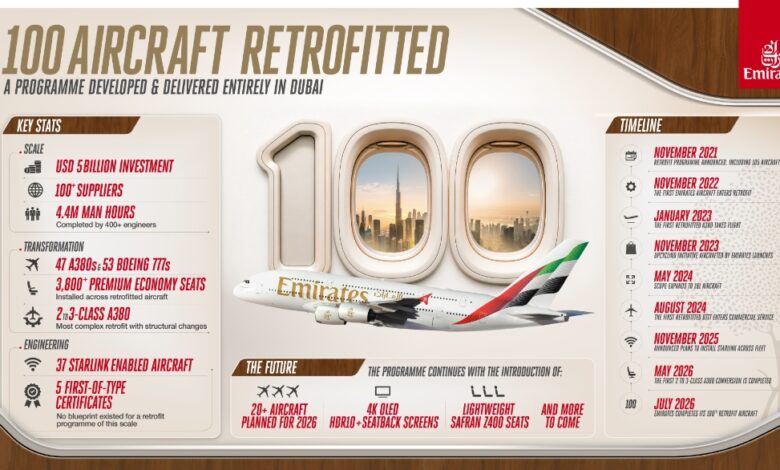
Emirates has reached a landmark 100 aircraft refurbished under its retrofit programme, the largest known undertaken by any airline globally. Since work began in November 2022, 47 Airbus A380s and 53 Boeing 777s have been given a complete nose-to-tail refresh at the Emirates Engineering hangars in Dubai. By the end of December 2026, around 20 additional aircraft will be upgraded, moving the airline significantly past the halfway point in its US$ 5 billion investment aimed at delivering a consistently elevated experience to customers.
Over a period of 44 months, the Emirates Engineering team has deployed more than 400 engineers and technicians, investing a collective 4.4 million man hours to transform 100 aircraft and deliver a sophisticated upgrade across the cabin interiors of all the aircraft.
Every aircraft was also fitted out with a new Premium Economy Cabin during the retrofit. More than 3,800 new Premium Economy seats have been installed in total as part of the initiative, accelerating the rollout of this much sought-after product to more routes across Emirates’ network, with more opportunities for customers to experience the highly acclaimed cabins.
Sir Tim Clark, President Emirates Airline said: “Our commitment to deliver best-in-class products across every cabin is an ongoing endeavour, and completing full cabin retrofits for 100 wide-body aircraft in 44 months is a significant achievement. Backed by a US$5 billion investment, it ensures our customers ‘fly better,’ with elevated luxury, comfort, and thoughtful detail throughout each cabin. Executing a project of this magnitude and complexity entirely inhouse has also required unmatched planning, precision, craftsmanship and technical capabilities here in Dubai. Our team has completely rewritten the rulebook on retrofitting the two largest passenger aircraft in commercial aviation to make sure that every aircraft returns to the skies on schedule and in impeccable shape.”
Engineering the Upgrade
Since the project began in November 2022, the Emirates Engineering team has retrofitted an average of 28 aircraft a year. As part of every retrofit, engineers completely take apart the interiors of the aircraft, execute a thorough refresh across all cabins armed with 4000+ parts for an A380 aircraft and 2500+ parts for a Boeing 777 aircraft and then put everything back together with precision.
Emirates’ Engineering team also developed innovative solutions to handle a project of monumental scale including the use of modified catering trucks inside the hangars to move large parts to and from the retrofit workshop to the aircraft. In addition to developing zonal work progress tracking and specialised parts storage and retrieval procedures, the team has also designed and manufactured several pieces of specialised equipment for moving components and accessing all areas of the interior of the aircraft for the retrofit. Emirates Engineering has worked with over 100 suppliers to execute this ambitious project.
From Blueprint to the Runway
Emirates’ retrofit programme was first announced in November 2021 covering 105 aircraft from the airline’s fleet. In November 2022, the very first Emirates aircraft, an Airbus A380, underwent retrofit at the Emirates Engineering hangars in Dubai. By May 2024, underlined by strong customer demand, the retrofit initiative was expanded to cover 191 aircraft and then to 219 aircraft by the end of the year. In August 2024, the first Boeing 777 retrofitted in Dubai entered commercial service.
More recently, in May 2026, the Emirates Engineering team completed the two to three class retrofit of an A380, a project involving important structural changes to the aircraft including the introduction of Premium Economy Cabin in the upper deck of the aircraft for the very first time. Starting October 2026, the Emirates retrofit programme will enter its next phase with the installation of 4K OLED HDR10+ display screens on aircraft seatbacks along with the introduction of the new lightweight Safran Z400 seats, among other product modifications.
Upcycling
In line with its commitment to sustainability, thousands of kilograms of high-grade leather, fabrics and other materials removed from retrofitted aircraft are being upcycled into a variety of limited-edition collector pieces such as luggage items under the ‘Aircrafted by Emirates’ range. Emirates has also distributed over 4,000 backpacks made from repurposed Economy Class seat fabric to children across 11 countries.